The different cableways
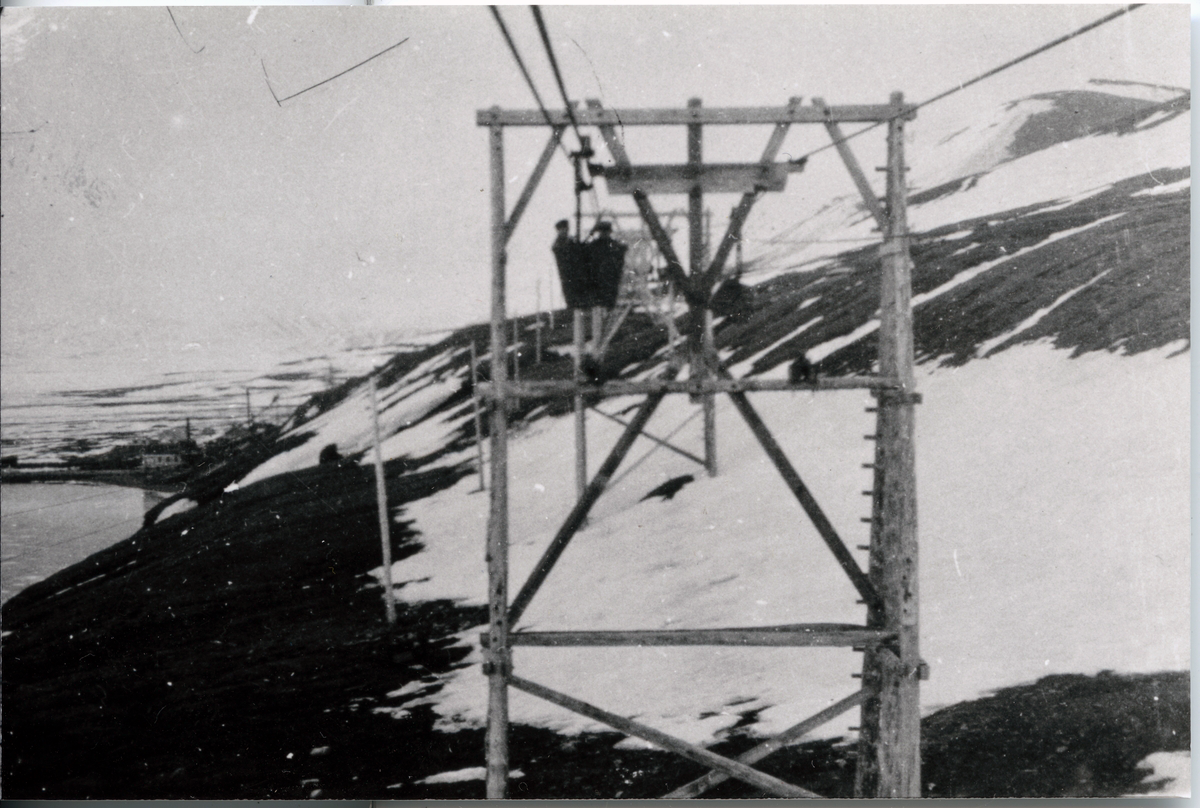
From 1908 to 1987, the cableway was the lifeblood of the transportation of coal from the mine to the coal storage and shipping dock. In the 1980s, transport by truck became more and more common, and today all transport is carried out this way. Cableways as a transportation system are an old invention, but it was only in the latter half of the 19th century that the cableway was developed and used for industrial purposes. The line in Longyearbyen has largely been of the "German system", with a fixed support cable between the towers of the cableway, and an "endless" traction line that pulls the buckets in an "eternal" circular path. The circular path principle is particularly useful since the buckets can be released from the traction cable at the stations without the line being stopped.
The cableway had its own tensioning stations along the track. The largest weights were 40 tons on the load side, and these rose and fell depending on load, wind and temperature. The dimension of the support wire on Line no. 5 was 45 mm on the load side, and 28 mm on the empty side (Line no. 3 had a diameter of 38 mm on the empty side). The traction rope that pulled the buckets along the track was tensioned with weights and large wheels at the stations. The tension in the wire was automatically controlled and adjusted according to wind and temperature. For Line no. 6, the wind tolerance limit was 25 m/s, at which point it automatically disengaged. If the tailwind was too strong, the empty bucket could be lifted off the support wire. The normal speed of the cableway was between 2.4 and 2.5 m/s, and it had a capacity of 125 tons per day. The distance between the buckets was automatically regulated to 48.5 m, and each bucket carried 7-800 kilos.
The cableway was perhaps the workplace in Longyearbyen where you got the strongest sense of the inhospitable Arctic climate. In the beginning, almost all workplaces on the cableway were without proper walls and heating. Most of the control and maintenance work naturally had to be done outdoors.
“Many times I could be bored and think life was meaningless. But I wouldn’t have been without it, and it was the people who made it worth it.” Even though the job at the Taubanesentralen involved a lot of hard work and freezing, most people look back on the work with joy. A little friendly bullying occurred to encourage effort: “But there was never any hostility, (...) a lot of bullying, but it kept the spirits up.”
Working with the cables and the traction rope was the real speciality of the workers who worked on the cableway. During these jobs, time was short. Accidents tended to occur in the coldest and worst weather conditions, but this also created a special bond between the cable workers. It was about staying on until the job was finished: "You didn't deny yourself anything”. “It was a break from the daily routine - everyone was in a good mood and the boss joined the work - no difference in that. But it was cold."
Particularly the work on the cables were time-consuming and extensive work requiring 8 to 10 people, bulldozers and weights to hold the cable down during the splicing work with wedging or casting. Splicing the traction rope was less extensive, but it could take more than 12 hours. The most common was to use a long splice - the "Liverpool splice" - which required a workforce of 8 men. 36 m of wire was coiled up, 18 m on each side, and every other section of wire was cut off and replaced with a similar one on the other side.
The individual lines of the cableway:
Line no. 1a; connectedd the "American Mine" to the first coal storage at Skjæringa and the old shipping dock. The line was delivered by the German company Adolf Beichert & Co. and had a capacity of 100 tons of coal per hour. Due to the large height difference between the mine and the terminus at the dock, the line had to break the excess power. There was an automatic peak at the coal storage at Skjæringa. The line was in operation until the explosion in Mine no. 1, January 3, 1920. The length of the line was approx. 1.3 km.
Line no. 1b; connected the new Mine no. 1b at the bottom of Longyeardalen to Taubanesentralen at Skjæringa. The line was delivered by the German company Adolf Bleichert & Co. Activity began in October 1939, and apart from shutdown and some minor damage during the Second World War, the line was in operation until Mine no. 1b closed in 1958. The line was approximately 2.4 km long and operated at a speed of 2.6 m/s. There was a double-sided tensioning station on the line.
Line no. 2a; connected the first section of Mine no. 2 on the east side of Longyeardalen, to Taubanesentralen at Skjæringa. The line was purchased from the closed Salangen Bergverk as early as the autumn of 1917, but the line was not ready for operation until 18th of February 1921. The line was approx. 1.5 km long and was in operation until 1937. It is the only line in Longyearbyen that used steel towers.
Line no. 2b; connected the new Mine no. 2b section at the very bottom of the Longyeardalen, via an angle station, to the Taubanesentralen at Skjæringa. The line was supplied by Adolf Bleichert & Co. – came into operation in October 1937 and was closed around 1968. The line was out of service and suffered some damage during the Second World War and was also out of service from around 1960 to 1964. The line was approx. 1.9 km and was operated at a speed of 2.15 m/s.
Line no. 3; connected Taubanesentralen at Skjæringa to the turning station at Hotellneset. The line was supplied by Adolf Bleichert & Co., and had a length of approx. 2.5 km, and operated at a speed of 2.03 m/s. The line was opened in the summer of 1921, and was in operation until it closed in 1987. The facility suffered some damage during World War II but was reopened in 1946 and connected to Line no. 4 via a new angle station. The line had a double-sided tensioning station.
Line no. 4; connected the angle stations at Hotellneset, out along the coal storage and unloading facility. The facility with an automatic ending station was supplied by Breco and came into service in 1946. The line had a length of approx. 1 km, and operated at a speed of 1.35 m/s. The line was in operation until 1970.
Line no. 5; connected Mine no. 5 in Endalen, via an angle station, to Taubanesentralen at Skjæringa. The line was active in the season of 1959/60 and had one single-sided and two double-sided tensioning stations in addition to the automatic angle station. The facility was supplied by Pöhlig-Heckel-Bleichert and had a length of approx. 7.35 km. The line had an operating speed of between 2.4 and 2.5 m/s, and a loading capacity of approx. 125 tonnes/day. The section between the angle station and the Taubanesentralen operating until 1987.
Line no. 6; connected Mine no. 6 to the angle station in Endalen. The line was an extension of Line no. 5 from the angle station in Endalen to the new Mine no. 6 section. It was operating from 1969 to 1987. The length of the line was approx. 3.7 km.

