Out From the Mine
In the area around Longyearbyen there are five coal seams from the Tertiary period, 40-60 million years old. However, only the middle layer, the “Longyear Seam” as it is called in technical terms, is suitable for mining. The other seams are too thin or too poor quality. The coal seam is mainly flat, but faults and folds can create difficulties for mining. The Longyear Seam lies high above sea level and varies in thickness from about 50 cm to about 160 cm, with the lowest thickness in Mine no. 3 and the highest in Mine no. 7.
In mines with a thin coal seam, it was tradition with a manual production with hand-operated drills and cutting machines. The miners had to crawl into the production area and work lying down and crawling. From the production area, “Strossa” or “Longwall” the coal was transported by train to the day facility where it was weighed and tipped. The coal was sorted and cleaned, before being stored in the coal silo. From the silo it went via the discharge for further transportation by the cableway.
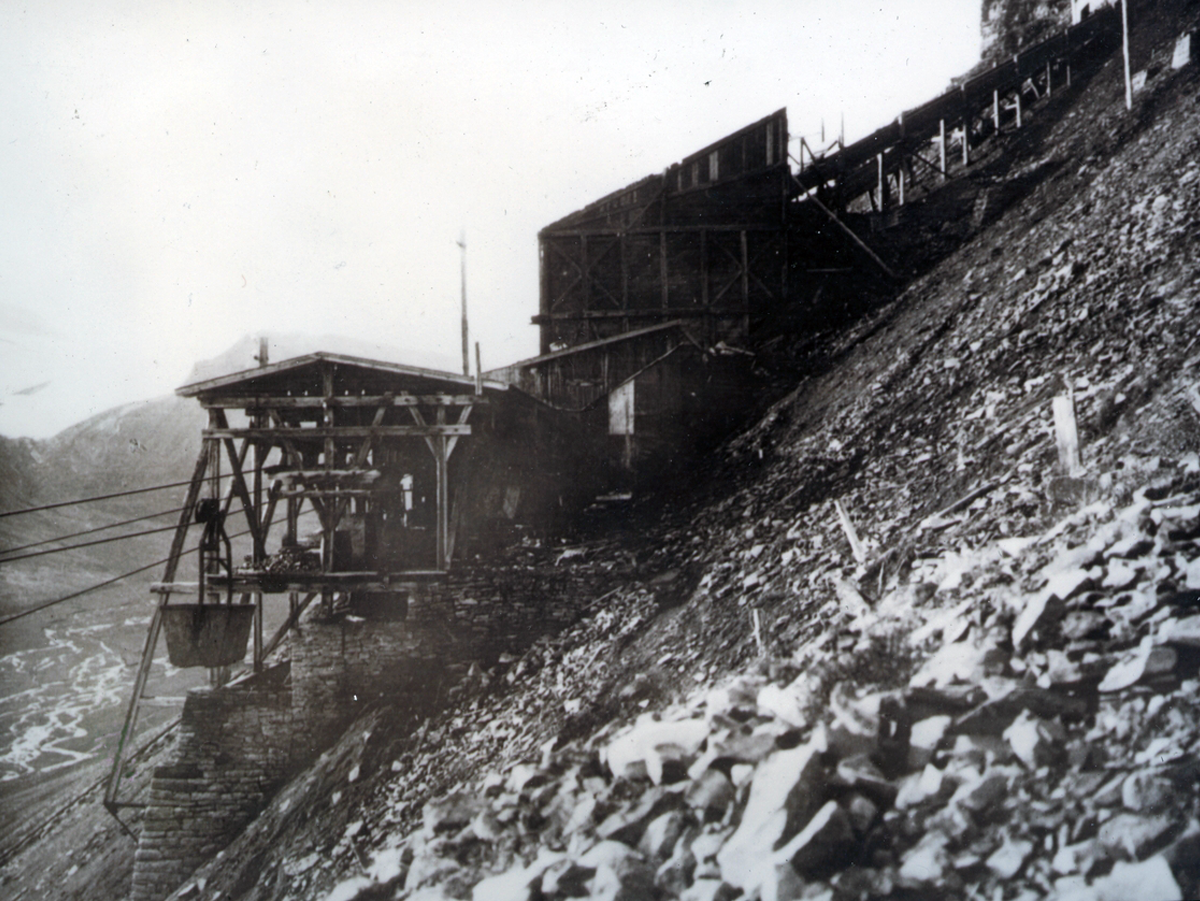
The load was the end station and rounding of the cable car. Here, the buckets were automatically disconnected from the traction rope and support cable, and manually or by help of a chain pull led past the tap hatches, before they were connected again to the cable car pull.
In the load of the oldest mines, three to four men worked, using a counterweight system to operate five taps to fill the buckets. In cold weather, it could be so dusty that you could not see when the bucket was full but had to use your hand to check.
In the day facility at Mine no. 5, work was made more efficient by installing compressed air to fill the buckets. Dust pollution was somewhat reduced, and now only two men were needed to operate five taps.
In Mine no. 6, which was the last to have cable car transport, fully automatic continuous filling of the buckets was introduced. They were guided around a rotating bunker that filled with a measured amount of coal. Two men were responsible for supervision on each shift. Until the cable car was closed, the coal from Mine no. 7 was transported by truck to the load at Mine no. 6.
The operation of the cable car depended on the amount of coal in the silo. Those working at the loading facility were responsible for measuring the silo level, a task that was done before and after each shift.
Mine no. 3 and Mine no. 7 have never had a cable car connection. The coal is transported by truck from the mine silos to the tip at the cleaning plant.
The operation in Mine no. 3 was partly traditional with crawling on low conditions. In Mine no. 7 the coal is mined with fully mechanized equipment, a continuous miner. The coal is transported out of the mine on a belt conveyor and temporarily stored in a coal silo. In Mine no. 3, transport took place with electronic mine locomotives and tipper wagons.
The individual mines
Mine no 1a
The mine was opened by the Americans in the summer of 1905, and at the same time a trolley line was built from the mine to the sea. Several buildings were erected at the mine, most of which were destroyed by a fire in 1912. New concrete buildings, a coal silo and a cable car outlet were built around 1913. On January 3, 1920, a large coal dust explosion occurred in the mine, killing 26 workers. After this, all operations from the site stopped.
Mine no 1b
Work on the mine began in the winter of 1938 and production was underway from the autumn of 1939. A 3 km road was also built into the valley to the mine. The coal silo at the mine held 2,500 tons, which was slightly more than at Mine no. 2. The facilities were not significantly damaged during the war, and operations resumed in 1945. Full operation continued until 1954. After a year's shutdown, operations continued until 1958. The facilities were torn down in 1982.
Mine no 2a
As early as 1912, investigations were carried out for the opening of a new mine entrance. In 1917, SNSK purchased a cable car to the mine, and in 1919 the mountain lift to the mine was completed. Operations began around 1921. The coal was transported by coal chute from the mine to a coal silo and cable car loading facility located lower down the mountain slope. The entrance was closed in 1937 and later destroyed during the war.
Mine no. 2b
In 1937, the new entrance to Mine 2 was opened, approximately 2 km before the old one. A silo and loading facility for the cable car were built in addition to a mountain lift and other buildings. Much of the facility was destroyed during the war, and there were also long-standing problems with a persistent fire in parts of the mine. After the war, the facility was rebuilt, and the mine was the main mine until approximately 1959. After several temporary interruptions of operation, the mine was closed in 1968. Large parts of the open pit are intact.
Mine no. 3
The mine was opened in 1969. Operations have been regulated since around 1972. All transport from the mine was by truck. The mine was in production from until 1996.
Mine no. 4
The first impact in the mine was made as early as 1954, and in 1960 the mine was cleared as a reserve mine. Due to difficult production conditions, the mine was only in production for a short period from around 1966 to 1970. All coal transport took place via Mine no. 2. There was therefore only a small extension at the impact.
Mine no. 5
The mine was the first outside Longyeardalen itself. Work began in the period 1954-59. Work on building the open pit and road to the mine took place until it opened for operations in 1959. Mine no. 5 was the main mine until 1969 and was in operation until 1971.
Mine no. 6
In 1965, a test pit was operated in the Mine no. 6 field. Mining operations in the mine began in 1969. Production conditions were very problematic, and operations in the mine were stopped in 1981: although there is still a coal reserve in the mine.
Mine no. 7
The first tests in the Mine no. 7 field were completed in the early 1960s. Operation of the mine was approved in 1972, but ordinary operations did not begin until the operating year 1975/76. After a shutdown in 1978, operations resumed in 1981. The coal is transported in pipes from the day facilities to the coal silo at the foot of the mountain, and then by truck. Operations in Mine no. 7 will be closed in the summer of 2025.

